






On 28 October, InterPED took part in the 2nd meeting of the BRIDGE Strategies of Engagement Sub-group, which focused on “Energy Literacy — Enhancing Citizens’ and Consumers’ Knowledge and Understanding”.
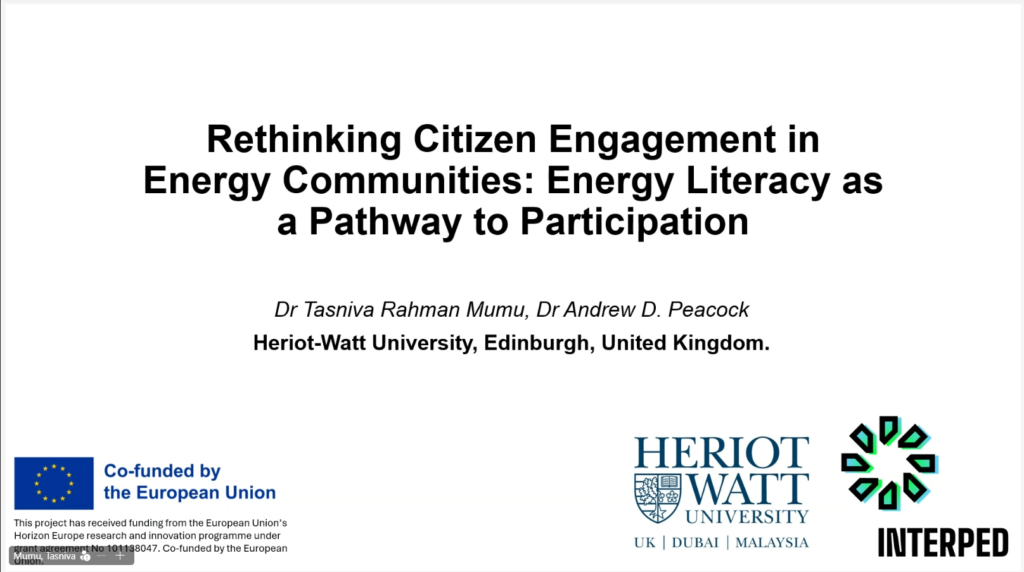
The online session explored how to strengthen citizens’ and consumers’ knowledge of energy-related issues and support informed decision-making. It looked in particular at knowledge gaps, access to clear and relevant information, and effective approaches to energy education.
Rethinking citizen participation in energy communities
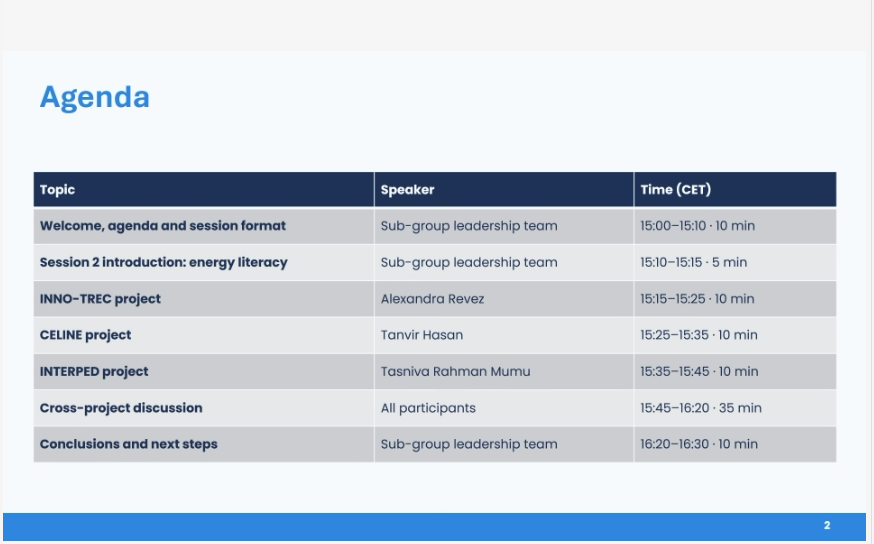
Representing InterPED, Dr Tasniva Rahman Mumu from our partner Heriot-Watt University presented “Rethinking Citizen Engagement in Energy Communities: Energy Literacy as a Pathway to Participation”, co-authored with Dr Andrew D. Peacock.
The presentation started from the EU Clean Energy Package, which frames decarbonisation as a social and democratic process. Citizens are placed at the centre of a just transition, with an emphasis on collective ownership, local governance and community benefits. However, setting up an energy community does not on its own guarantee meaningful inclusion, because participation is not equally accessible to everyone.
Key points raised included:
- From consumers to ecological citizens: energy communities should move beyond seeing people as individual, rational consumers. They should embrace “ecological citizenship”, based on shared responsibility, collective governance and agency that grows over time.
- Beyond one-off engagement: many current models rely on short-term activities such as single consultations or crowdfunding campaigns, without a clear understanding of how long-term change in citizen participation happens.
- Energy literacy as a process, not a prerequisite: rather than a threshold people must meet before taking part, energy literacy should be seen as something that develops naturally through participation and peer-to-peer learning, widening access instead of limiting it.
A four-stage engagement framework, tested in InterPED pilots
Heriot-Watt University is developing a four-stage engagement framework across InterPED’s four European pilots, in which participation itself becomes the learning mechanism. The framework is designed to support peer-to-peer knowledge exchange without relying on expert facilitation, so that citizens can lead and own the process.
Early pilot experiences are promising:
- Scotland: after an initial energy literacy session run in person by the research team, participants envisioned their community’s energy future and identified barriers through peer learning.
- Romania: local partners ran the workshop on their own, without expert facilitators present, showing that the framework can work independently.
Opening the discussion
The presentation closed with questions for the group:
- How does citizen participation grow over time within local communities?
- How can we observe energy literacy evolving through participation in practice?
- Can energy literacy act as the main gateway to setting up energy communities and driving peer-to-peer learning?
These questions fed into a lively cross-project discussion with the INNO-TREC and CELINE projects and other BRIDGE members.
Through its active involvement in the BRIDGE initiative, InterPED continues to share its pilot experience on citizen engagement. It contributes to a European exchange on how to make energy communities and Positive Energy Districts more inclusive and participatory.