















Positive Energy Districts (PEDs) are designed to integrate renewable energy generation, storage systems, smart buildings, electric mobility, and active consumers into a coordinated local energy ecosystem. As these districts become increasingly complex, simply monitoring energy consumption and production is no longer enough.
This blog builds on insights from Deliverable D6.1 – Demand-side Flexibility Forecasters, publicly available on Zenodo. The deliverable presents the forecasting services developed within the InterPED project to predict electricity demand, thermal loads, renewable energy generation, and electric vehicle charging behaviour, supporting smarter energy management and demand-side flexibility in Positive Energy Districts.
As renewable energy sources, storage systems, and flexible demand become more common in urban districts, forecasting is emerging as a critical capability for managing increasingly dynamic energy systems.
The Limits of Monitoring
Modern energy systems generate enormous amounts of data. Smart meters, sensors, building management systems, photovoltaic installations, and charging stations continuously provide information about what is happening across a district.
Monitoring helps operators understand current conditions. However, it only provides a picture of the present and the past.
The challenge is that many energy decisions must be taken before events occur. Operators need to know whether electricity demand will increase tomorrow, whether renewable generation will be sufficient during the afternoon, or whether EV charging demand will create additional stress on the local grid.
Without this knowledge, energy management remains reactive rather than proactive.
Why Prediction Matters
Forecasting transforms historical and real-time data into actionable intelligence.
Instead of asking “What is happening now?”, forecasting allows operators to ask:
- What will energy demand look like tomorrow?
- How much solar generation can be expected?
- When will peak consumption occur?
- How much flexibility will be available?
By answering these questions in advance, energy managers can prepare control strategies, optimise energy resources, and improve overall system efficiency.
Forecasting as a Foundation for Flexibility
Demand-side flexibility depends on anticipating future conditions.
When forecasts indicate an upcoming peak in demand, flexibility resources such as batteries, thermal storage systems, heat pumps, or EV charging infrastructure can be prepared accordingly.
Similarly, forecasts of renewable generation can help maximise local energy use, reducing imports from the wider grid and increasing self-consumption within the district.
Forecasting therefore acts as the foundation upon which flexibility services are built.
From Forecasts to Action
Producing accurate forecasts is only part of the challenge. To create value, forecasts must be integrated into operational energy management processes and made available to other services responsible for optimisation and control.
Within InterPED, forecasting services are designed to continuously process energy data, generate predictions, and provide actionable information to platform components responsible for flexibility activation and energy management. This enables district operators and automated control systems to move beyond reactive responses and make decisions based on anticipated future conditions.
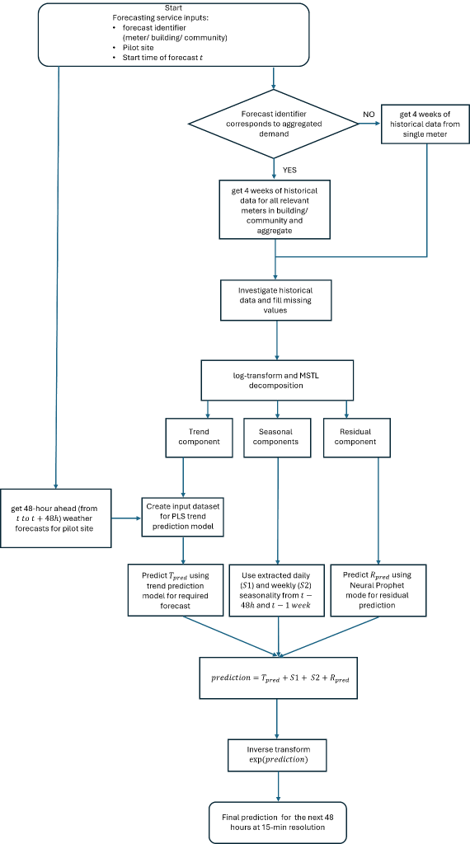
Figure 1 illustrates the execution workflow of the InterPED electrical demand forecasting service, demonstrating how historical data and forecasting models are transformed into actionable predictions that support wider district energy management and flexibility services.
Moving Towards Predictive Energy Management
As Europe moves towards more decentralised and renewable energy systems, predictive capabilities will become increasingly important.
Positive Energy Districts are not only expected to produce clean energy. They must also manage energy intelligently, adapt to changing conditions, and actively contribute to grid stability.
Projects such as InterPED demonstrate that forecasting services can play a central role in this transition, enabling districts to move from reactive monitoring towards predictive and proactive energy management. As Positive Energy Districts continue to evolve, forecasting will become an essential tool for improving flexibility, increasing renewable energy utilisation, and supporting more resilient local energy systems.
Readers interested in the technical foundations of these forecasting services can explore Deliverable D6.1 – Demand-side Flexibility Forecasters, publicly available on Zenodo, which provides a detailed overview of the methodologies, models, pilot implementations, and lessons learned presented in this article.