









Positive Energy Districts are often discussed in terms of their outcomes—energy surplus, emissions reduction, and system efficiency. Yet these outcomes are the result of coordinated processes taking place within the district.
Understanding PEDs therefore requires looking beyond high-level objectives and examining the use cases that define their operation.
This blog builds on Deliverable D3.2 – Demonstration Scenarios for InterPED Validation, which outlines how specific use cases structure PED functionality across different pilot environments.
Use Cases as the Building Blocks of PED Operation
In complex systems such as PEDs, use cases provide a practical way to organise system behaviour.
Each use case defines:
- a specific operational objective
- the actors and technologies involved
- the interactions required to achieve the desired outcome
Rather than analysing the system as a whole, use cases allow PEDs to be understood as a set of coordinated processes.
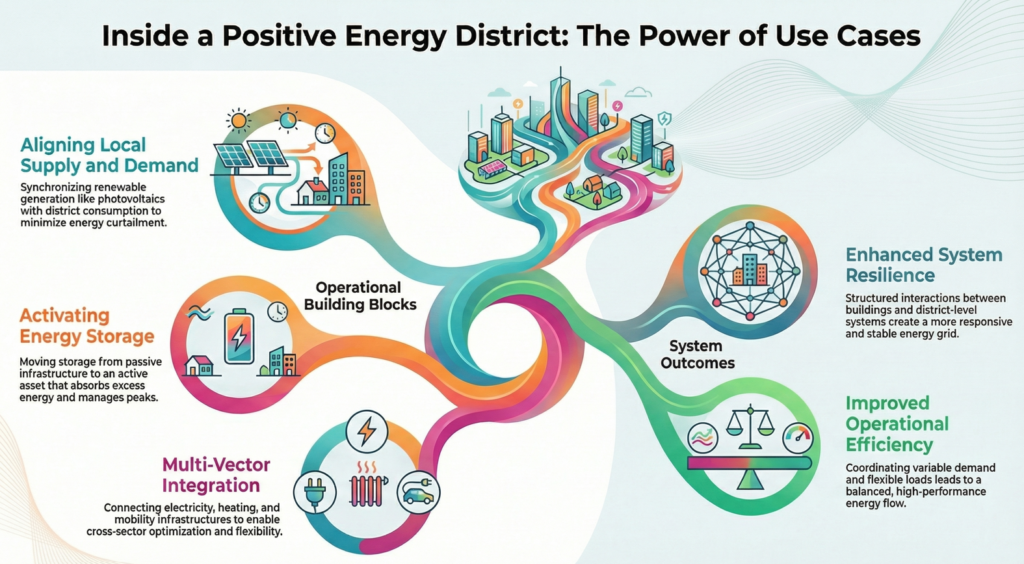
Managing Renewable Energy within the District
One of the core use cases in PEDs focuses on the integration of renewable energy sources.
This involves:
- aligning generation from sources such as photovoltaics with local demand
- minimising energy curtailment
- ensuring efficient utilisation of locally produced energy
By structuring how renewable energy is managed, these use cases help maximise the contribution of local generation to district performance.
Coordinating Demand and Consumption Patterns
Energy demand in urban districts is highly variable, influenced by user behaviour, building characteristics, and external conditions.
Use cases related to demand management address this variability by enabling:
- adaptive consumption patterns
- shifting of flexible loads
- coordination between buildings and district-level systems
Through these mechanisms, energy demand becomes a manageable and responsive component of the system.
Integrating Storage as an Operational Asset
Storage plays a critical role in balancing energy flows within PEDs. However, its value depends on how it is integrated into system operation.
Use cases define how storage systems:
- absorb excess energy during periods of high generation
- release energy during peak demand
- interact with other system components
This transforms storage from a passive infrastructure element into an active contributor to system optimisation.
Connecting Multiple Energy Vectors
PEDs are characterised by the integration of multiple energy vectors, including electricity, heating, and mobility.
Use cases enable this integration by defining how:
- energy flows are coordinated across systems
- different infrastructures interact
- cross-sector optimisation is achieved
This interconnected approach allows PEDs to function as multi-vector energy systems, increasing overall efficiency and flexibility.
From Use Cases to System Performance
While each use case addresses a specific aspect of system operation, their combined effect determines overall district performance.
By structuring interactions between technologies, users, and infrastructures, use cases create the conditions for:
- balanced energy flows
- improved system resilience
- enhanced operational efficiency
Understanding these underlying processes provides a clearer picture of how PEDs deliver their intended outcomes.
Making PEDs Operational
Positive Energy Districts are not defined only by their goals but by the processes that enable them.
By translating system complexity into structured use cases, InterPED provides a framework for understanding, implementing, and evaluating PED operation in real-world conditions.
Readers interested in exploring these operational dynamics in more detail can access Deliverable D3.2 – Demonstration Scenarios for InterPED Validation.