















As Positive Energy Districts move from concept to implementation, a critical question emerges: how can their performance be measured and validated in real-world conditions?
Validation is essential not only for demonstrating technical feasibility but also for ensuring that PED solutions can be scaled, replicated, and integrated into broader energy systems.
This blog draws on Deliverable D3.2 – Demonstration Scenarios for InterPED Validation, which establishes the foundation for testing and evaluating PED operation across pilot sites.
Why Validation Matters
PEDs combine multiple technologies, stakeholders, and infrastructures within a single operational environment. This complexity makes performance assessment particularly challenging.
Validation provides a structured approach to:
- observe how systems behave under real conditions
- identify strengths and limitations
- generate evidence to support replication
Without validation, PEDs remain experimental concepts rather than deployable solutions.
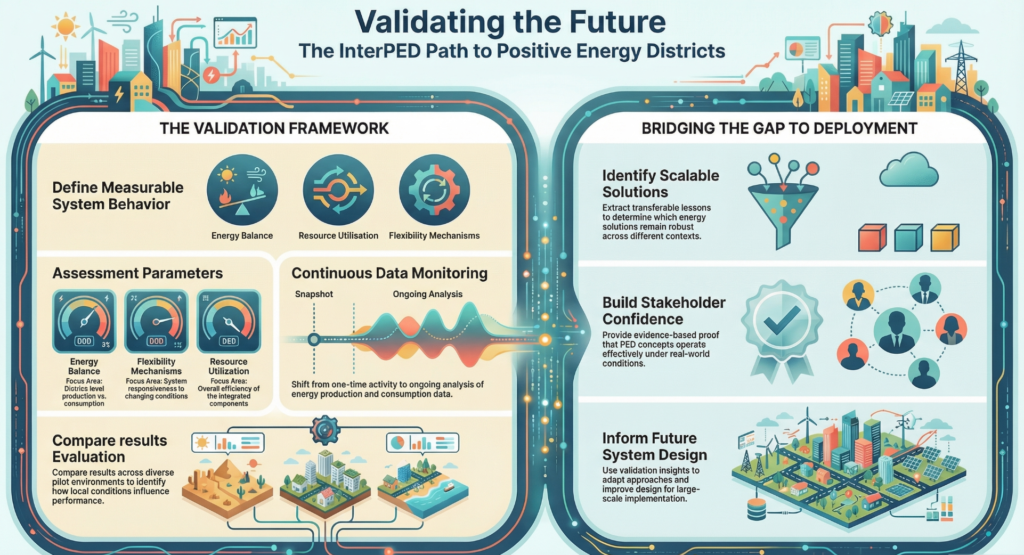
Defining Measurable System Behaviour
Validation begins with defining what should be measured.
Demonstration scenarios establish clear parameters for assessing:
- energy balance at district level
- efficiency of resource utilisation
- responsiveness of flexibility mechanisms
- interaction between system components
These parameters ensure that evaluation goes beyond isolated indicators and captures the systemic performance of PEDs.
Monitoring as a Continuous Process
Validation is not a one-time activity but an ongoing process supported by monitoring systems.
These systems collect and analyse data related to:
• energy production and consumption
• system operation under different conditions
• performance of control strategies
Continuous monitoring allows project teams to track system evolution and adjust operational strategies where needed.
Comparing Performance Across Contexts
One of the strengths of the InterPED approach lies in its ability to compare results across diverse pilot environments.
By applying consistent validation frameworks, it becomes possible to:
- identify patterns across different contexts
- understand how local conditions influence performance
- extract transferable lessons
This comparative perspective is essential for developing scalable PED solutions.
Linking Validation to Future Deployment
Validation results are not only used to assess current performance but also to inform future development.
They provide insights into:
- which solutions are robust across different contexts
- which approaches require adaptation
- how system design can be improved
In this way, validation becomes a bridge between pilot implementation and large-scale deployment.
Building Confidence in PED Solutions
For Positive Energy Districts to become a mainstream component of urban energy systems, stakeholders must have confidence in their performance.
By establishing structured validation processes, InterPED contributes to building this confidence, providing evidence that PED concepts can operate effectively under real-world conditions.
Readers interested in understanding how PED performance is assessed and validated can explore Deliverable D3.2 – Demonstration Scenarios for InterPED Validation.