







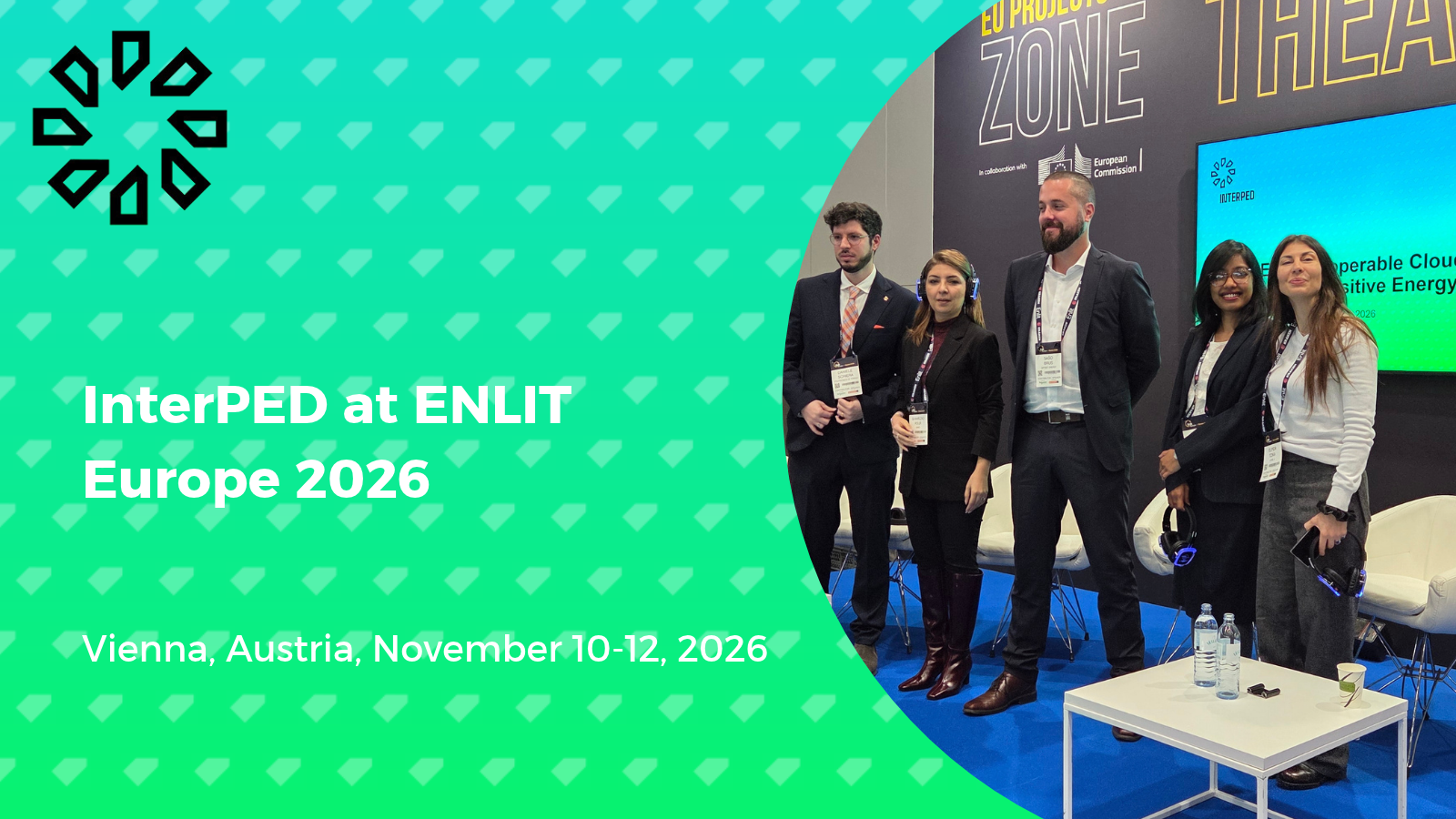
InterPED at ENLIT Europe 2026: putting citizens at the heart of Positive Energy Districts
From 10 to 12 November 2026, InterPED joined ENLIT Europe in Vienna, presenting its interoperable approach to Positive Energy Districts at the EU Projects Zone and sharing what the project has learnt from working with communities on the ground.
ENLIT Europe is one of Europe’s largest events for the energy transition, bringing together utilities, technology providers, policymakers and researchers. This year, InterPED was part of the EU Projects Zone under the theme Integrating Energy Futures, alongside other Horizon Europe projects working on smart communities, digital energy systems and Positive Energy Districts (PEDs).
The ENLIT participation was coordinated by Level 9, InterPED’s dissemination and communication partner, which also brought together the projects sharing the two EU Projects Zone booths.
At the booth: Smart Communities & Positive Energy Districts
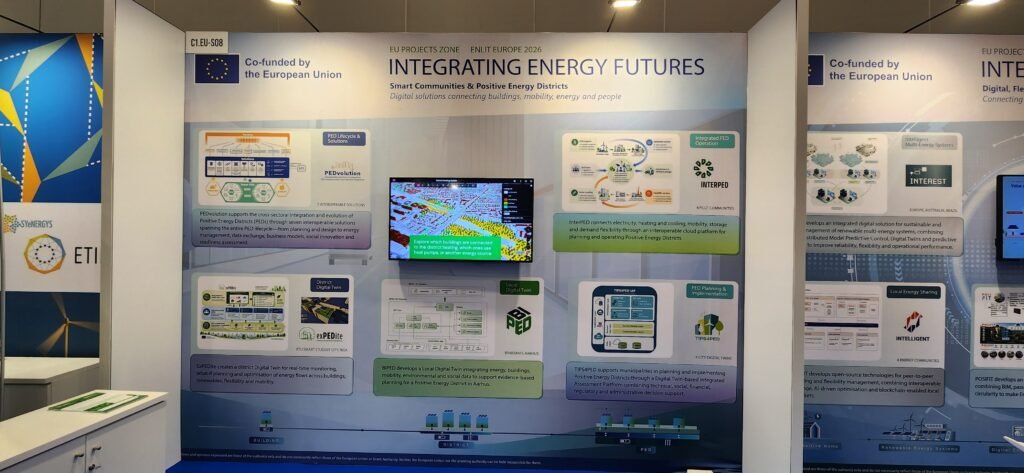
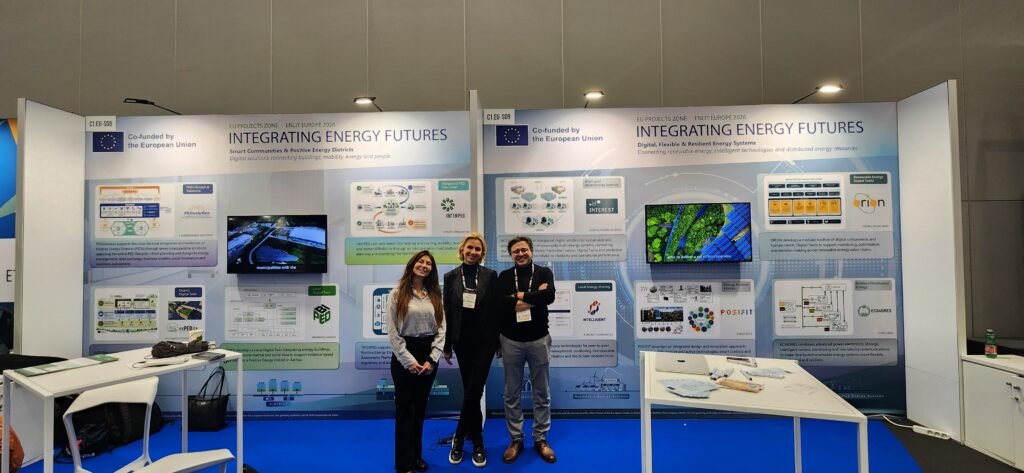
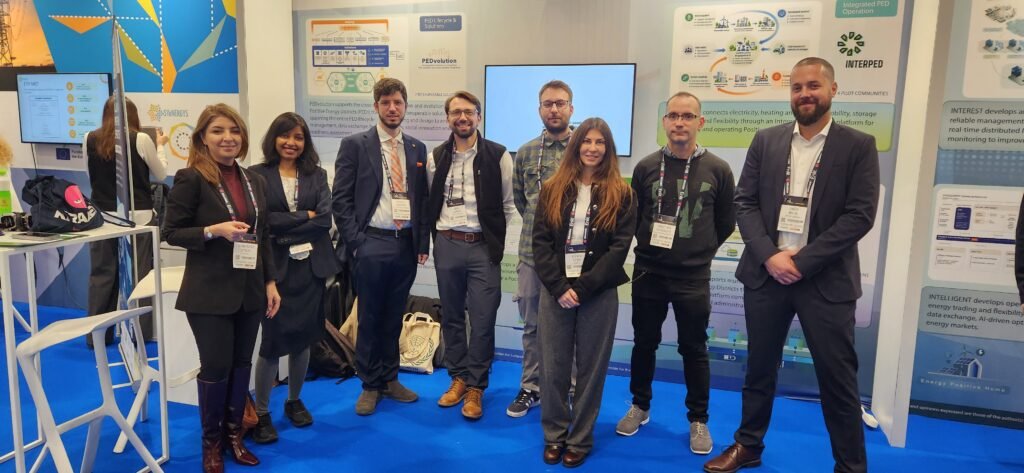
Throughout the three days, InterPED was present at booth C1.EU-S08, Smart Communities & Positive Energy Districts – Digital solutions connecting buildings, mobility, energy and people, together with PEDvolution, EXPEDITE, BIPED and TIPS4PED. Next door, booth C1.EU-S09 brought together cluster projects working on digital, flexible and resilient energy systems.
At the booth, visitors could discover how InterPED connects electricity, heating and cooling, mobility, storage and demand flexibility through an interoperable cloud platform for planning and operating Positive Energy Districts, tested in four pilot communities in Spain, Scotland, Switzerland and Romania.
The session: from technology to people
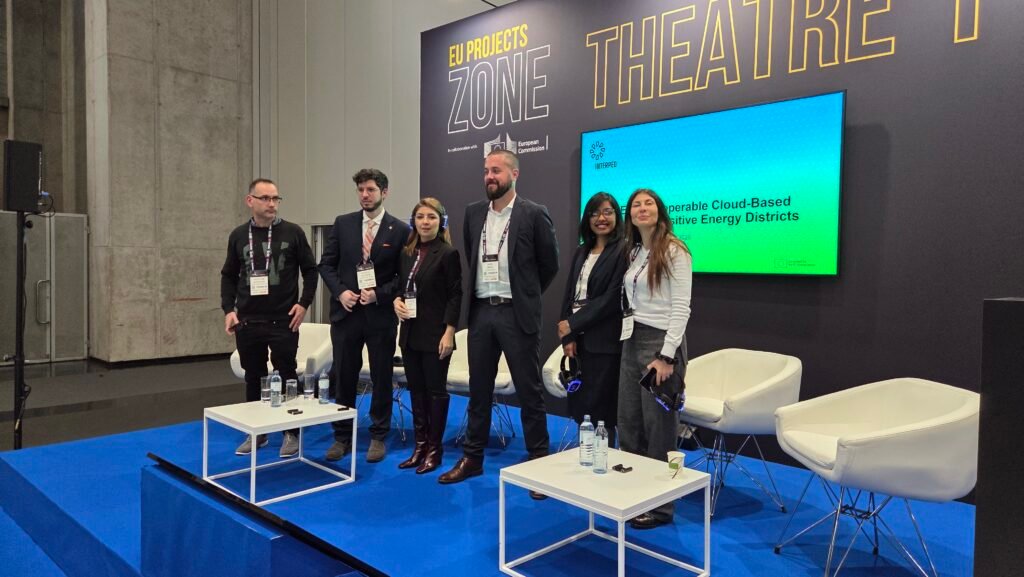
On Wednesday 11 November, from 12:00 to 13:00, the booth’s projects took the stage at the EU Projects Zone Theatre for the session Smart Communities & Positive Energy Districts. The session was moderated by Elpida Tzika, Dissemination & Communication Manager at Level 9, and each project gave a short presentation followed by a roundtable discussion.
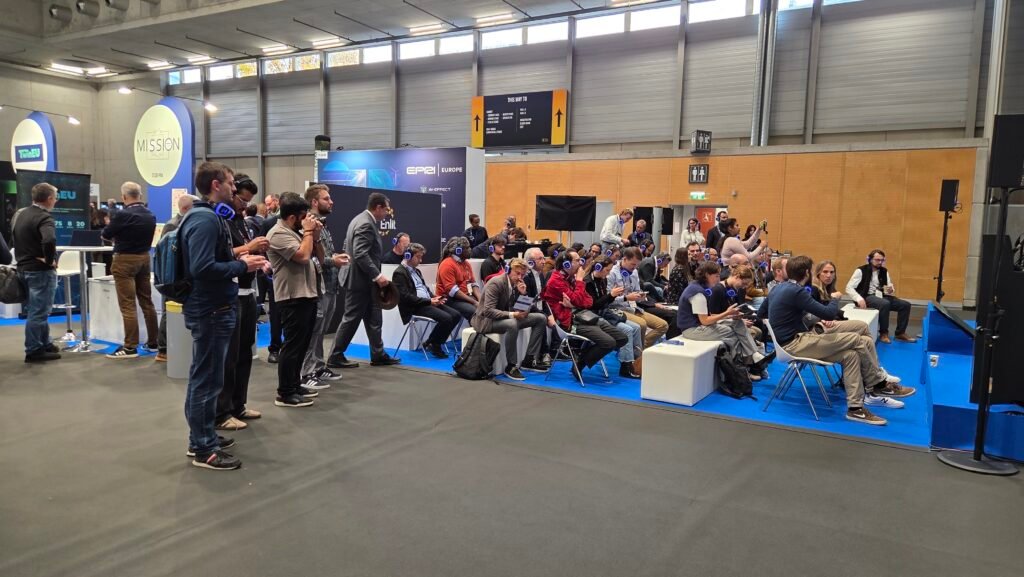
The session drew a large audience, with every seat taken and many attendees standing around the stage to follow the discussion through the event’s headsets.
Opening the session, Elpida presented InterPED. She explained how the project has developed tools and services to improve the management and energy efficiency of PEDs, including model predictive controllers, a cross-vector optimiser, an EV flexibility orchestrator and an energy hub. Its key innovation is interoperability: making sure all these tools communicate with each other, while each service is adapted to the context of each pilot.
But, as Elpida stressed, technology alone is not enough. A district can have the best infrastructure, but without people it is not a community. This is why stakeholder engagement is at the heart of InterPED, through a participatory design process with citizens: identifying the topics that matter with community leaders, developing simple materials such as picture cards, running participatory literacy sessions, and analysing the feedback together.
She also shared the main lessons learnt so far:
- Education and awareness must come before technology: what users do not understand cannot be automated.
- Energy literacy is not a prerequisite: it grows through participation and peer-to-peer learning.
- Participatory processes build lasting trust and long-term engagement.
- Regulation matters: without a legal framework for energy communities, the focus shifts from technology to bureaucracy.
- Citizens are the main actuators of a PED: their acceptance defines its success.
Roundtable: co-creating PEDs with communities
In the roundtable, InterPED was represented by Dr Tasniva Rahman Mumu, Research Associate at Heriot-Watt University, whose work focuses on energy communities, energy literacy, citizen engagement and inclusive participation in the energy transition.
Tasniva addressed the question: What participatory and co-creation approaches were designed and implemented across the InterPED pilot sites? She explained that one approach does not fit all, and that engagement in InterPED was tailored to each community:
- Lugaritz–Matía (Spain): with healthcare buildings and vulnerable users, the focus is on comfort, through a post-occupancy evaluation survey.
- Findhorn Ecovillage (Scotland, UK): in a close-knit residential community, deep participation through co-creation workshops.
- Arena Innovation Community (Switzerland): educational workshops and simulation tools to explore energy scenarios.
- Alba Iulia (Romania): with public and tertiary buildings, visioning workshops and work on the legal framework for energy communities.
The discussion with the other projects showed how much PEDs share, from planning and digital twins to replication in new cities, and confirmed a common message: the success of a Positive Energy District depends as much on people as on technology.
Stronger together
ENLIT Europe 2026 was also a great opportunity to strengthen collaboration with fellow EU-funded projects working towards the same goal. We warmly thank PEDvolution, EXPEDITE, BIPED and TIPS4PED for an inspiring session, the projects of the Digital, Flexible & Resilient Energy Systems booth, the ENLIT and EU Projects Zone teams, and everyone who visited the booth and joined the discussion.
A full recap of both EU Projects Zone booths and sessions will follow in a special edition of the InterPED newsletter. To stay updated, follow InterPED on LinkedIn, X and Bluesky, and subscribe to our newsletter.