















Positive Energy Districts (PEDs) are emerging as a key instrument in Europe’s transition toward climate-neutral cities. However, scaling PED concepts beyond individual pilot sites remains a major challenge. While technological solutions are advancing rapidly, replication requires a deeper understanding of the operational conditions, governance models, and systemic factors that shape district-level energy systems.
This blog builds on insights from Deliverable D3.1 – Pilot Operational Characterization and Global Challenges, publicly available on Zenodo. The deliverable explores the broader policy and regulatory landscape surrounding PED deployment across Europe and highlights the structural conditions shaping implementation.
Why pilot characterisation matters
PED initiatives are often tested in pilot districts designed to explore innovative combinations of renewable generation, energy storage, digital management systems, and citizen participation. However, pilots are not isolated experiments. Their value lies in generating knowledge that can inform the development of future districts.
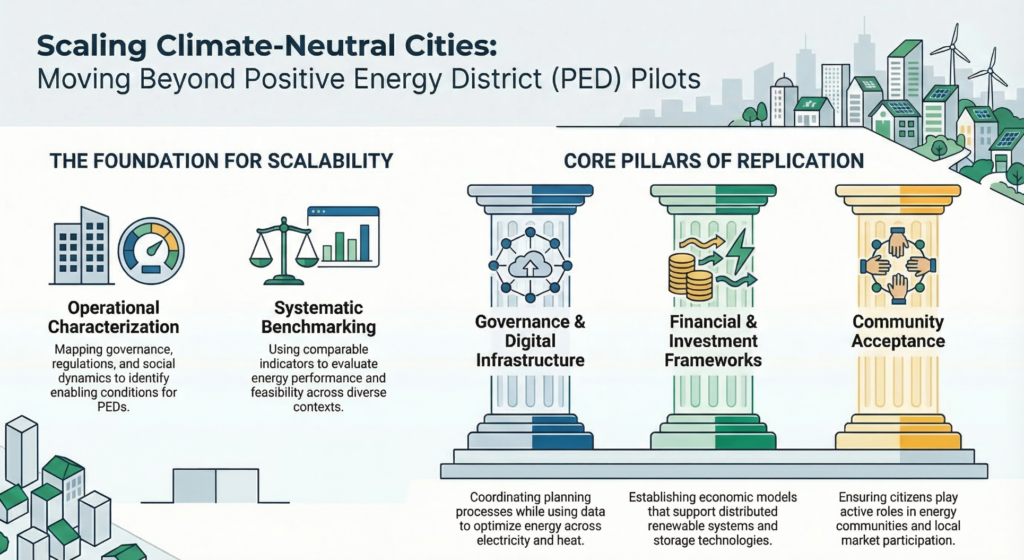
Operational characterisation provides a structured way to understand how each pilot functions within its local context. Rather than focusing solely on technology, the characterisation process examines multiple dimensions of the district ecosystem. These include energy infrastructure, governance arrangements, local regulatory frameworks, climatic conditions, and social dynamics.
By mapping these factors, project partners can identify the enabling conditions that allow PED solutions to operate effectively. Equally important, the process helps uncover the constraints that may limit the transferability of certain approaches to other cities or regions.
A benchmarking approach for comparing districts
One of the challenges in PED development is the diversity of urban contexts across Europe. Districts differ significantly in building density, energy system structures, ownership models, and local governance capacities. As a result, comparing pilot sites requires a common analytical framework.
Benchmarking provides this framework by allowing different districts to be evaluated using comparable indicators and assessment criteria. These indicators typically examine energy performance, system integration, flexibility potential, and operational feasibility.
Rather than identifying a single “best-performing” model, benchmarking highlights patterns and relationships across different contexts. For example, a district with strong renewable production may face limitations related to grid infrastructure or regulatory barriers, while another district may demonstrate strong governance structures but limited local generation capacity.
These insights help researchers and practitioners understand how different factors interact to shape the operational performance of PED systems.
Replicability criteria: moving beyond technology
Replication of PED concepts cannot rely solely on technological solutions. Successful replication requires a broader set of criteria that account for institutional, economic, and social conditions.
Several factors play a critical role in determining whether a PED model can be replicated elsewhere.
First, governance capacity is essential. Local authorities, utilities, and community organisations must be able to coordinate planning processes, regulatory compliance, and stakeholder engagement.
Second, data and digital infrastructure must support monitoring, optimisation, and decision-making across multiple energy vectors such as electricity, heating, and mobility.
Third, financial and investment frameworks must enable the deployment of distributed renewable systems, storage technologies, and digital platforms.
Finally, community acceptance and participation remain fundamental. Citizens increasingly play an active role in energy communities, demand response programmes, and local energy markets.
Replication, therefore, depends not only on technological maturity but also on the ability of local ecosystems to support integrated energy governance.
Lessons for future Positive Energy Districts
The experience gathered from pilot characterisation provides valuable guidance for future PED initiatives. Several key lessons are emerging from ongoing research and implementation efforts.
First, PED development should be approached as a systemic transformation process, not merely as a technical upgrade. Energy, mobility, buildings, and digital systems must be considered together within an integrated urban framework.
Second, standardised assessment methodologies are essential to ensure that insights from pilots can be compared and shared across projects and cities.
Third, flexibility and adaptability are critical design principles. PED solutions must be capable of adjusting to different regulatory environments, market conditions, and infrastructure constraints.
Finally, the long-term success of PEDs will depend on collaboration across disciplines and sectors, including urban planning, energy engineering, digital systems, policy development, and community engagement.
Building the foundations for scalable PEDs
Positive Energy Districts represent an important step toward climate-neutral urban systems, but their widespread adoption requires structured learning from existing pilots. Characterisation methodologies and benchmarking approaches help transform pilot experiences into actionable knowledge that can guide future district development.
Readers interested in the policy and regulatory foundations behind PED deployment can explore the D3.1 – Pilot Operational Characterization and Global Challenges, which offers a structured overview of these conditions and highlights the systemic dimensions that must be addressed alongside technology.