









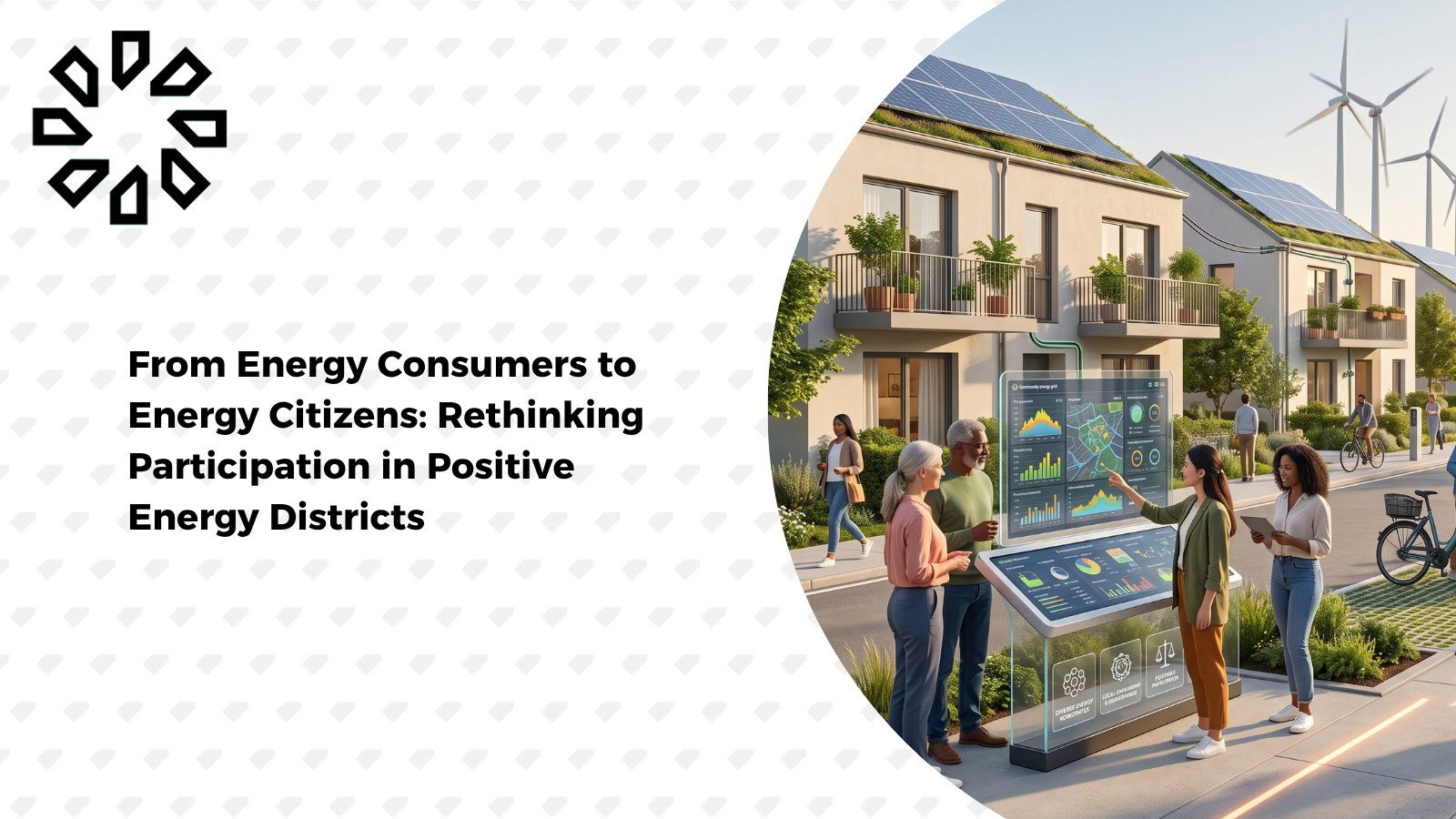
Europe’s transition towards climate-neutral cities is changing not only how energy is generated and managed, but also the role that people can play within the energy system.
Traditionally, most people have interacted with energy primarily as consumers: electricity and heat are supplied, bills are paid, and decisions about how the wider energy system operates remain largely elsewhere. The emergence of decentralised renewable generation, energy communities and Positive Energy Districts (PEDs) is beginning to challenge this relationship.
As energy systems become increasingly local, flexible and interconnected, citizens can potentially take on much more active roles. Understanding what this transition means is an important part of designing PEDs that work not only technically, but also for the communities and people they serve.
InterPED’s public Deliverable D4.1, Guidelines for user recruitment and engagement, explores this evolving relationship between communities, citizens and decentralised energy systems.
What do we mean by an energy community?
There is no single model of an energy community.
Communities may be organised around a particular place, such as a neighbourhood, town or municipality. Others can develop around a particular sector, shared interest, technology or network of people. Some communities may even exist primarily through digital connections rather than within a clearly defined geographical area.
This distinction matters because the way a community is organised can influence its governance, infrastructure, business model and, importantly, how people participate.
A locally owned renewable energy initiative, for example, may require very different forms of participation from a commercially oriented energy project or a virtual community connecting geographically dispersed prosumers.
From passive consumers to active participants
Decentralised energy systems create opportunities for people to take on roles that extend beyond conventional energy consumption.
Households can increasingly generate electricity through rooftop photovoltaics, use storage technologies, adapt consumption according to energy-system conditions and participate in different forms of local energy exchange.
But greater technical possibilities do not automatically create active citizens.
InterPED’s research distinguishes between different possible levels of user involvement. At one end of the spectrum, people may remain relatively close to the conventional consumer model, adopting technologies while much of the control remains automated or managed by other actors. At the other end, people may become much more actively involved, interacting with control systems, adapting energy use and potentially contributing to wider decisions about the local energy system.
These roles are not fixed. The appropriate level of participation may differ between projects, between people within the same project and over time as technologies, markets and people’s energy literacy evolve.
What is an “energy citizen”?
This evolving role has contributed to the concept of energy citizenship.
The idea reflects a broader shift in which people can become more involved in how energy is produced, governed and used. In this context, participation may extend beyond individual economic decisions towards collective concerns about the future of the energy system.
D4.1 places this discussion alongside the concept of ecological citizenship, which broadens conventional understandings of citizenship by considering environmental responsibilities, justice and impacts that can extend beyond national borders and across generations.
This is particularly relevant to the energy transition. Decisions about energy use, infrastructure and decarbonisation can have environmental and social consequences far beyond an individual household.
Energy citizenship therefore opens the possibility of viewing people not simply as customers of an energy system, but as actors who may progressively participate in shaping it.
Not everyone will participate in the same way
An important conclusion from InterPED’s analysis is that we should not assume that every person wants—or is immediately able—to become a highly active energy citizen.
Energy communities are diverse, and so are the people within them.
Some may be motivated by environmental objectives. Others may primarily be interested in affordability, comfort or reliability. Some may want to participate in governance or collective decision-making, while others may prefer limited involvement.
Levels of energy literacy, available time, financial resources, trust, technology ownership and local social and cultural conditions can all influence participation.
This means that successful participation cannot simply depend on asking citizens to fit a predefined model of the “ideal” energy citizen. Instead, engagement approaches need to recognise where people currently stand and provide opportunities for their involvement to evolve at an appropriate pace.
Why this matters for Positive Energy Districts
PEDs bring together buildings, renewable generation, energy infrastructure, mobility, ICT systems and users within increasingly integrated local energy systems.
This creates new possibilities for optimisation and flexibility—but also new relationships between technologies and people.
For PEDs to achieve their wider social and environmental potential, technical innovation therefore needs to be accompanied by an understanding of the people and communities interacting with these systems.
For InterPED, this means looking beyond the question of how much energy a district can produce, consume or exchange and asking another important question:
What role do people want and need to play within that energy system?
Recognising that there can be different answers is an important starting point for designing meaningful participation.
Towards citizen-centred energy transitions
The transition from passive energy consumption towards more active forms of energy citizenship will not happen overnight, nor will it follow the same pathway everywhere.
Different communities will have different objectives, governance structures, technologies and levels of citizen involvement. People themselves will also have different motivations and capacities to participate.
Rather than treating this diversity as a barrier, InterPED’s work suggests that it should become a starting point for designing participation.
Understanding who the participants are, what type of community they belong to and what role they wish to play can help create energy systems in which technological innovation and community needs evolve together.
Learn more
This article draws on the InterPED public deliverable:
Peacock, A. (2024). D4.1: Guidelines for user recruitment and engagement. Zenodo.