













Positive Energy Districts (PEDs) are often described in terms of their potential to transform urban energy systems. However, moving from concept to implementation requires more than strategic vision. It requires concrete operational scenarios that define how technologies, infrastructures, and stakeholders interact in real environments.
This blog builds on insights from Deliverable D3.2 – Demonstration Scenarios for InterPED Validation, which focuses on how PED solutions are structured, deployed, and tested across different pilot contexts.
Turning system complexity into operational scenarios
PEDs operate across interconnected systems, including electricity, heating, cooling, mobility, and storage. Managing these interactions requires clearly defined operational logic.
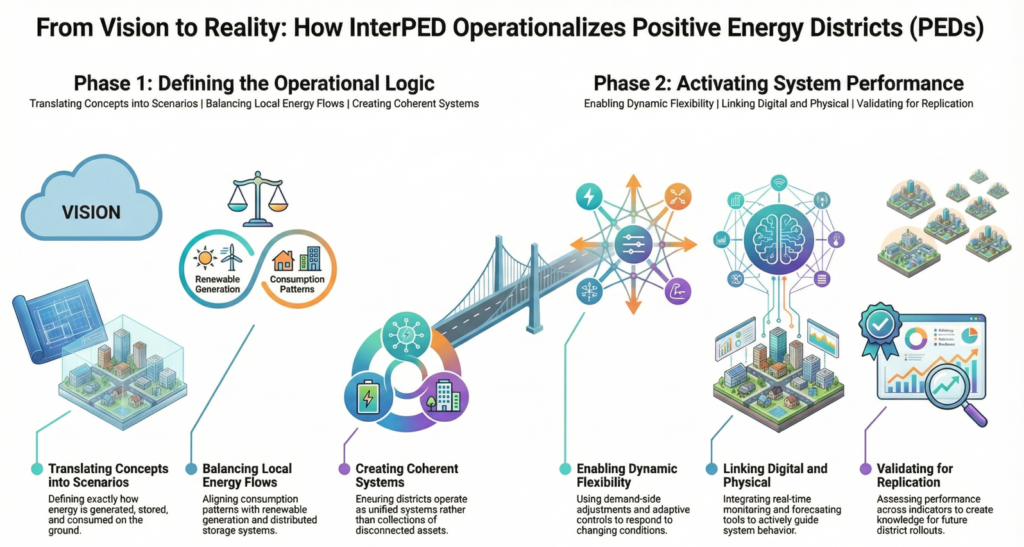
Demonstration scenarios provide this structure. They translate high-level objectives into concrete actions, defining:
- how energy is generated, stored, and consumed
- how flexibility is activated
- how different system components interact under varying conditions
Rather than treating PEDs as abstract systems, scenarios describe what actually happens on the ground.
Structuring energy flows at District Level
One of the central challenges in PED implementation is balancing energy production and demand within dynamic and distributed environments.
The InterPED scenarios address this by defining coordinated strategies for:
- integrating renewable energy generation into local demand
- managing distributed storage systems
- aligning consumption patterns with energy availability
These strategies enable districts to operate as coherent energy systems, rather than collections of disconnected assets.
Enabling flexibility through System Coordination
Flexibility is a key requirement for maintaining balance in PEDs. However, flexibility is not a single technology—it is an operational capability emerging from coordinated system behaviour.
Within the demonstration scenarios, flexibility is enabled through:
- demand-side adjustments based on system conditions
- coordinated operation of storage technologies
- adaptive control of building energy systems
This coordinated approach allows districts to respond dynamically to changes in generation, demand, and external conditions.
Bridging Digital Systems and Physical Infrastructure
Demonstration scenarios also play a critical role in linking digital platforms with physical energy systems.
Operational strategies are supported by:
- real-time monitoring systems
- forecasting tools for demand and generation
- optimisation mechanisms that guide system behaviour
Through this integration, digital systems move beyond passive monitoring and become active components of energy system operation.
Preparing for Validation and Replication
Beyond implementation, scenarios also define how PED performance will be evaluated.
They establish the foundation for:
- monitoring system behaviour under real conditions
- assessing performance across multiple indicators
- comparing outcomes across different pilot environments
This structured approach ensures that insights from demonstration activities can be translated into replicable knowledge for future districts.
From Concept to Operational Reality
While earlier analyses highlight the challenges and conditions shaping PED deployment, demonstration scenarios represent the next critical step: implementation.
By defining how technologies, data, and stakeholders interact in practice, InterPED moves from conceptual frameworks toward operational energy systems capable of delivering measurable impact.
Readers interested in how these scenarios are structured and applied across pilot sites can explore D3.2 – Demonstration Scenarios for InterPED Validation.