














Across Europe, cities are exploring Positive Energy Districts (PEDs) as a pathway toward climate neutrality. These districts aim to produce more renewable energy than they consume annually while integrating electricity, heating, mobility, and digital energy management systems.
Yet one of the most important lessons emerging from European research and innovation projects is that Positive Energy Districts do not look the same everywhere.
Climate conditions, existing energy infrastructure, governance models, and urban density all shape how PED solutions can be designed and implemented. What works in one city may require significant adaptation in another.
This blog builds on insights from Deliverable D3.1 – Pilot Operational Characterization and Global Challenges, publicly available on Zenodo. The deliverable explores the broader policy and regulatory landscape surrounding PED deployment across Europe and highlights the structural conditions shaping implementation.
Why context matters for Positive Energy Districts
The concept of Positive Energy Districts is often described as a technological transformation. However, the transition to energy-positive urban systems is also shaped by local environmental, institutional, and spatial conditions.
The InterPED project investigates these dynamics through four diverse pilot locations located in Scotland, Switzerland, Spain, and Romania.
Each of these pilots operates within different climatic zones, regulatory frameworks, and urban structures. As a result, the design of PED solutions must adapt to the specific conditions of each location rather than follow a uniform model.
Climate conditions influence energy strategies
Climate is one of the most immediate factors influencing PED design.
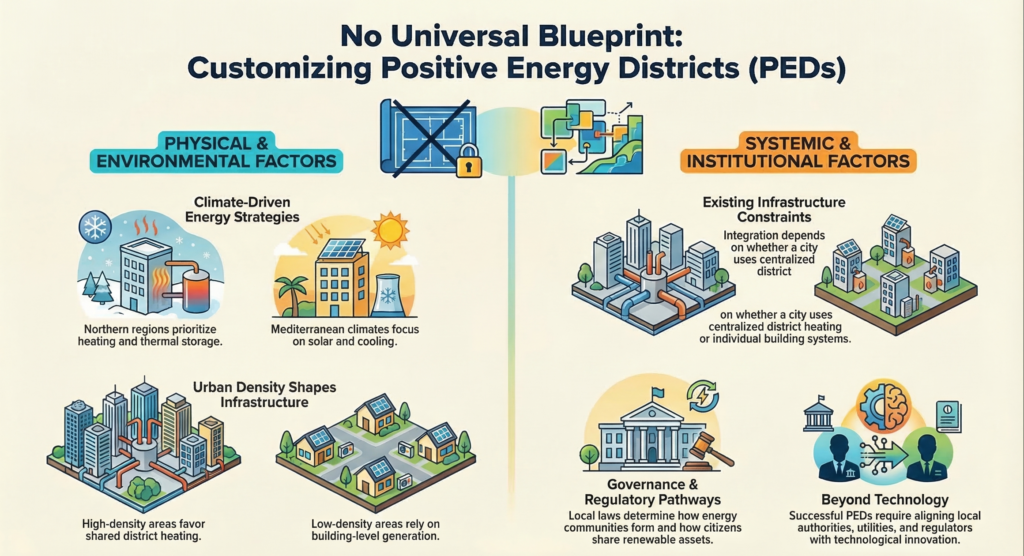
In colder regions such as northern Europe, heating demand plays a central role in district energy planning. Renewable heating technologies, heat pumps, and thermal storage systems become essential to balancing energy supply and demand during the winter months.
In milder Mediterranean climates, cooling demand and solar generation profiles shape energy management strategies differently. Solar photovoltaics may provide higher annual generation potential, while building design and demand flexibility become critical to managing summer energy loads.
These climatic variations mean that PED energy strategies must be tailored to local weather patterns and seasonal demand profiles.
Energy system structures shape integration possibilities
Another important difference between European cities lies in their existing energy infrastructures.
Some cities operate extensive district heating networks or community energy systems that allow energy resources to be shared across buildings. Others rely heavily on individual building-level systems or national electricity grids.
The InterPED pilots demonstrate how PED implementation must account for these structural realities. In some locations, energy sharing and peer-to-peer trading models can be integrated relatively easily, while in others, new digital platforms and infrastructure are required to enable energy coordination.
Understanding how local energy systems are organised is therefore a critical first step in designing scalable PED solutions.
Governance models influence implementation pathways
Positive Energy Districts are not only technical systems—they are also institutional and governance innovations.
Cities across Europe operate under different national regulations, market structures, and local governance arrangements. These differences influence how energy communities are formed, how flexibility markets operate, and how renewable energy assets can be shared among citizens.
For example, some countries already provide regulatory frameworks for energy communities and local energy sharing, while others are still developing legal definitions and market rules for these models.
As a result, PED implementation often requires alignment between local authorities, utilities, regulators, and citizens, alongside technological innovation.
Urban density shapes the scale of PED solutions
The physical structure of cities also plays a decisive role.
High-density urban districts provide opportunities for shared infrastructure such as district heating networks, community storage systems, and integrated mobility solutions.
In contrast, lower-density areas may rely more heavily on building-level renewable generation and distributed energy management.
The InterPED pilots illustrate how PED approaches can emerge in very different urban contexts, from dense city environments to community-based energy initiatives. Each configuration requires different system architectures, governance arrangements, and participation models.
No single blueprint for Positive Energy Districts
Taken together, these differences reveal a crucial insight: there is no universal template for Positive Energy Districts.
Instead, PEDs should be understood as locally adapted systems, shaped by climate conditions, existing infrastructure, governance frameworks, and spatial characteristics.
The diversity of the InterPED pilot sites demonstrates that successful PED development requires flexible methodologies capable of adapting to different contexts rather than imposing standardised technical solutions.
Understanding the systemic conditions behind PED deployment
The experience of the InterPED pilots highlights that implementing Positive Energy Districts is not only about deploying renewable technologies or smart energy platforms.
It also requires navigating regulatory frameworks, aligning stakeholders, adapting to local energy infrastructures, and designing solutions that fit the spatial and social characteristics of each district.
Readers interested in the policy and regulatory foundations behind PED deployment can explore the full deliverable Deliverable D3.1 – Pilot Operational Characterization and Global Challenges on Zenodo, which offers a structured overview of these conditions and highlights the systemic dimensions that must be addressed alongside technology.