















Europe’s transition toward climate-neutral cities increasingly relies on the development of Positive Energy Districts (PEDs)—urban areas that produce more energy than they consume while integrating renewable generation, storage, and flexible demand.
Yet achieving this vision requires more than deploying renewable technologies. PEDs depend on complex digital ecosystems capable of managing energy flows, coordinating multiple infrastructures, and enabling data-driven decision making.
This blog builds on insights from Deliverable D3.1 – Pilot Operational Characterization and Global Challenges, publicly available on Zenodo. The deliverable explores the broader policy and regulatory landscape surrounding PED deployment across Europe and highlights the structural conditions shaping implementation.
Why digitalisation matters for PEDs
Unlike traditional energy systems built around centralized generation, PEDs operate within distributed and interconnected energy environments. Electricity, heating, cooling, mobility systems, and storage technologies interact dynamically at the district level.
Managing these interactions requires continuous data collection, real-time monitoring, and coordinated system optimisation. Digital platforms and interoperable systems therefore become essential components of PED infrastructure.
Without robust digital integration, the growing number of distributed energy resources, from rooftop photovoltaics to electric vehicles and heat pumps, cannot be effectively coordinated.
Data management as the foundation
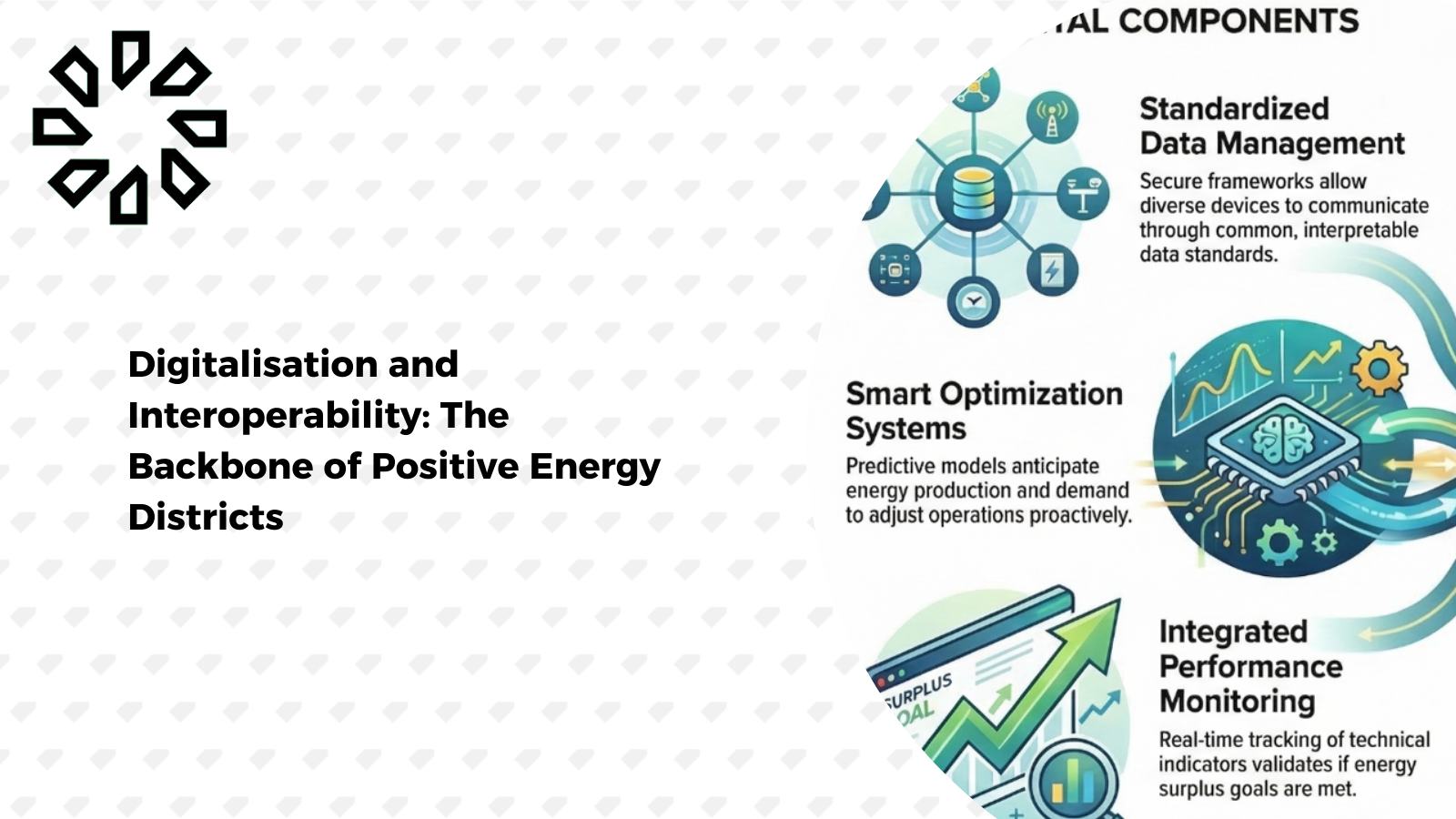
At the core of PED digital ecosystems lies data management. Sensors, smart meters, and digital platforms generate large volumes of information related to energy production, consumption patterns, grid conditions, and user behaviour.
Effective PED operation depends on the ability to:
- collect reliable data from heterogeneous devices and infrastructures
- process and analyse information in near real time
- translate technical data into actionable insights for system operators and communities
Standardised data models and secure data-sharing frameworks are essential to ensure that information from different sources can be combined and interpreted correctly. Without common standards, the integration of multiple technologies becomes technically complex and costly.
Smart systems enabling coordinated energy management
Digitalisation also enables the deployment of smart energy management systems capable of optimising district-level energy flows.
These systems integrate forecasting tools, optimisation algorithms, and automation mechanisms that help balance renewable generation with local demand. For example, predictive models can anticipate solar production, electricity demand, or heating needs, allowing the system to adjust operations proactively.
Through these capabilities, smart systems support:
- demand response strategies
- optimal scheduling of flexible loads
- coordination of distributed storage and renewable generation
In PED environments, such capabilities help ensure that local energy production is used efficiently while maintaining system stability and comfort for residents.
Monitoring and performance validation
Monitoring is another critical pillar of PED digital ecosystems. Because PEDs combine multiple technologies and infrastructures, evaluating their performance requires integrated monitoring systems capable of tracking technical, environmental, and operational indicators.
Monitoring platforms allow project teams and city stakeholders to observe:
- renewable energy production and consumption patterns
- flexibility activation and demand response behaviour
- energy balance and system efficiency at district scale
This continuous monitoring supports evidence-based decision making, enabling operators to refine system operation and evaluate whether PED objectives, such as energy surplus or emissions reduction, are being achieved.
Cross-vector integration across energy systems
One of the defining characteristics of Positive Energy Districts is cross-vector integration. Instead of treating electricity, heating, mobility, and storage as separate systems, PEDs aim to coordinate these infrastructures within a single operational framework.
Digital platforms enable this integration by connecting technologies that traditionally function independently. For example:
- electric vehicles can interact with local energy systems as mobile storage units
- heat pumps can shift electricity consumption based on renewable availability
- building energy systems can coordinate with district-level flexibility strategies
Through digital coordination, PEDs can transform multiple energy vectors into a flexible and adaptive urban energy ecosystem.
Interoperability as the key to scalability
While digitalisation enables advanced energy management, interoperability determines whether PED solutions can scale and replicate across cities.
Urban energy systems involve technologies developed by different manufacturers, platforms built on different software architectures, and regulatory environments that vary across regions. Without interoperability standards, integrating these systems becomes difficult and costly.
Interoperable architectures allow platforms to communicate through common protocols, shared data models, and standardised interfaces, ensuring that new technologies can be integrated without redesigning the entire system.
For PEDs, interoperability is therefore not simply a technical detail. Interoperability is a precondition for large-scale deployment and replication across Europe.
Building the digital backbone of future energy districts
As European cities move toward climate neutrality, Positive Energy Districts will increasingly rely on digital infrastructures capable of managing complex, distributed energy systems.
Digitalisation enables real-time monitoring, advanced forecasting, and coordinated optimisation, while interoperability ensures that these capabilities can operate across diverse technologies and institutional contexts.
Together, these elements form the digital backbone that allows PEDs to function as integrated urban energy systems rather than isolated technological installations.
Readers interested in the policy and regulatory foundations behind PED deployment can explore the Deliverable D3.1 – Pilot Operational Characterization and Global Challenges, which offers a structured overview of these conditions and highlights the systemic dimensions that must be addressed alongside technology.