








Positive Energy Districts may share a common ambition to support the transition towards climate-neutral cities, but the communities in which they operate can be fundamentally different.
A residential ecovillage is not the same as a healthcare complex. A district combining housing and public facilities presents different participation opportunities from an educational campus. The people interacting with these environments also have different relationships with their buildings and energy systems.
For this reason, applying the same citizen-engagement strategy everywhere would overlook one of the defining characteristics of PEDs: their local context.
InterPED addresses this challenge through participatory strategies designed around the characteristics of its pilot communities. The approach is presented in the project’s public Deliverable D4.1, Guidelines for user recruitment and engagement, publicly available on Zenodo.
Why a single engagement model is not enough
InterPED’s four pilots combine very different types of buildings, technologies and communities.
The Lugaritz-Matía Community in Spain includes a hospital and assisted-living buildings. Findhorn Ecovillage in the UK has a residential community and a strong community-energy dimension. The Swiss pilot combines residential and other facilities, while the Romanian pilot is centred around an educational campus.
These differences affect a fundamental question:
Who should actually participate?
In some PEDs, residents may be directly involved as active citizens. Elsewhere, the most relevant participants may be building users, staff, students, facility managers, local authorities, energy companies or other stakeholders.
D4.1 therefore rejects the assumption that every PED automatically requires the same type or level of citizen participation. Instead, InterPED matches participatory techniques to the characteristics of the project, community and people involved.
When “citizen engagement” is not the right approach
The Lugaritz-Matía pilot provides a particularly clear example.
The pilot consists of a newly built hospital and two nursing buildings for assisted living. In this context, D4.1 does not propose conventional citizen engagement.
Instead, it identifies post-occupancy evaluation as a more appropriate way to understand people’s experiences of the buildings.
Building users such as staff and patients can provide information about comfort and their perception of building performance—for example, whether spaces feel too hot or cold, noisy, stuffy or fresh, whether lighting works well, and whether users feel they have adequate control over their indoor environment.
This information can then be considered alongside the original design intentions and the perspectives of the professionals involved in the building process.
The example illustrates a broader principle: meaningful participation does not necessarily mean maximising citizen involvement. It means identifying the people whose experiences and knowledge are relevant and choosing a method appropriate to their context.
A different context requires a different relationship
Findhorn Ecovillage represents a very different case.
Findhorn is the InterPED pilot with an explicit community-energy character and corresponding requirements for citizen engagement. This creates opportunities for more extensive participatory activity and for exploring how participation could become embedded over time within the governance of the PED.
Here, participation can go beyond collecting people’s experiences.
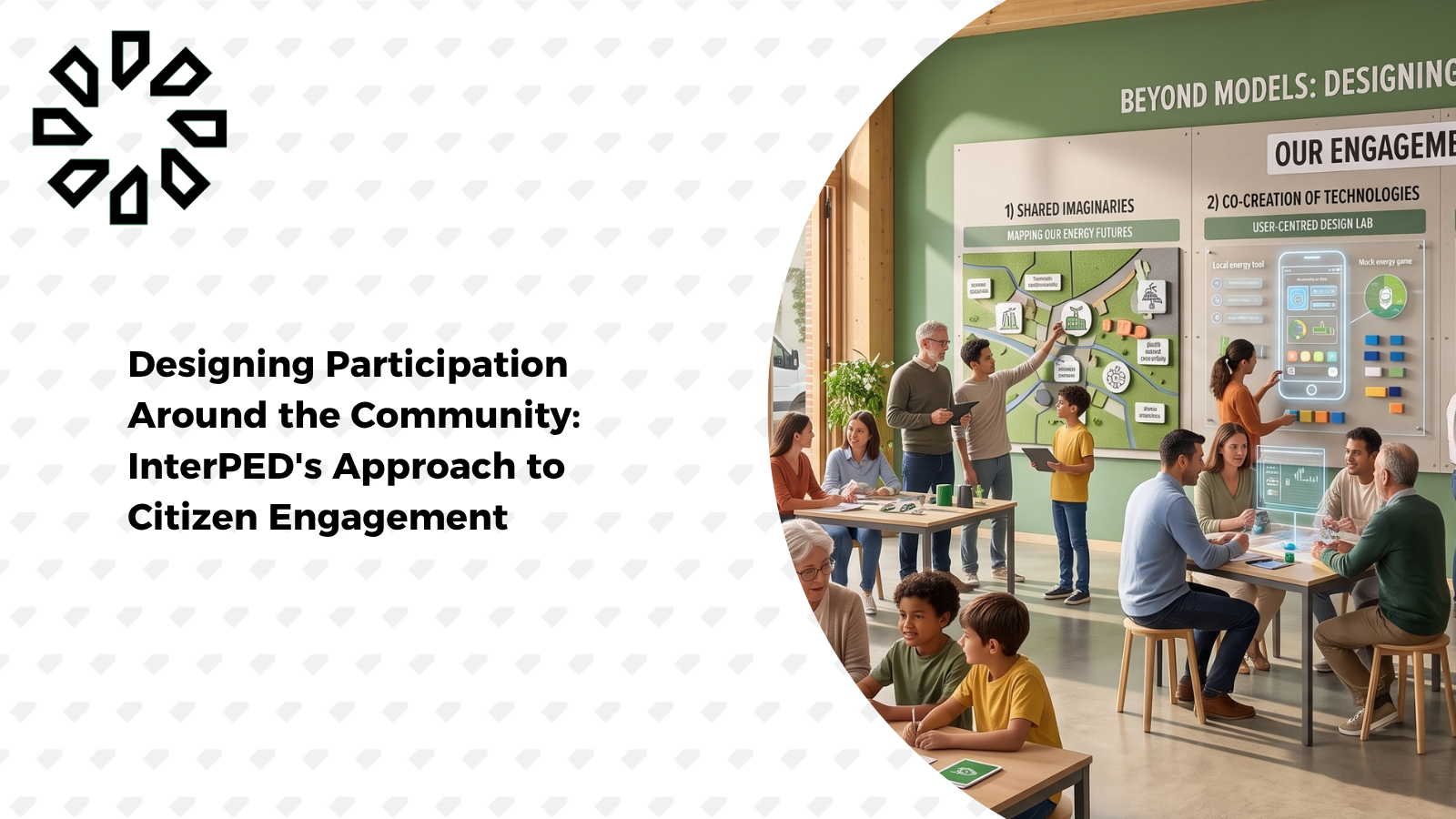
Activities can support the development of shared meanings around energy-system concepts, explore collective visions of the community’s energy future and provide input into issues such as demand-response strategies.
The difference between Findhorn and Lugaritz-Matía demonstrates precisely why the project does not start with a predetermined engagement tool.
It starts with the community.
Extending engagement to stakeholders and younger users
Other pilots introduce further variations.
At the Romanian educational pilot, for example,there are relevant stakeholders including energy-sector organisations, an energy agency and local authorities. At the same time, the college environment creates an opportunity to explore approaches specifically tailored to students, including smartphone-based questionnaires and energy games.
The objective is not to make every pilot’s engagement activities identical. InterPED instead seeks a degree of commonality where this is useful while preserving the ability to adapt methods to local circumstances.
For example, the development of shared meanings around energy-system elements and shared imaginaries was envisaged across several pilots, providing opportunities to understand how cultural and contextual factors influence both the participation process and its outcomes.
From four pilots towards a more generic framework
The diversity of the pilots raises a larger question for PED development:
Can we create a framework that helps other projects decide what kind of participation they need without imposing a one-size-fits-all method?
InterPED begins addressing this challenge by proposing a generic citizen-engagement framework.
Rather than prescribing a particular workshop or engagement technique, the framework starts by understanding the characteristics of the PED itself.
It considers questions such as the sector addressed by the PED, whether citizens are expected to participate actively, the typology of the project, and the type of citizens involved.
The underlying principle is simple: engagement should be shaped by context. Before selecting a participation method, projects need to understand the environment in which the PED operates, the characteristics of the people involved, and the role they can realistically play.
This provides a more adaptable basis for citizen engagement, allowing participation strategies to respond to the specific needs and characteristics of each PED rather than applying the same approach across very different communities.
Putting social context alongside technology
The afforementioned approaches addresses an important gap.
Tools supporting PED planning and operation tend to focus primarily on techno-economic considerations. Yet the expansion from individual buildings towards district-scale energy systems significantly increases the number and diversity of actors potentially involved—from citizens and property owners to local authorities, utilities, network operators, facility managers and energy-service providers.
These stakeholders differ in energy literacy, responsibilities, resources, interests and availability.
Participation therefore cannot simply be added at the end of PED development as a communication activity.
It needs to be considered as part of the broader design of the local energy system.
Towards adaptable engagement for future PEDs
InterPED’s work points towards an engagement model that is context-sensitive rather than prescriptive.
Some PEDs may require extensive community participation and governance. Others may benefit primarily from engagement with particular building users or professional stakeholders. Different techniques may also become appropriate as a PED develops and people’s roles evolve.
The goal is therefore not to identify the single “best” citizen-engagement method.
It is to develop a structured way of identifying which forms of participation make sense, for which people, in which type of PED and for which purpose.
By testing this thinking across very different pilot environments, InterPED is contributing to a broader understanding of how the human and technical dimensions of Positive Energy Districts can be considered together.
And that may be essential for moving from technically capable PEDs towards districts that also reflect the needs, experiences and ambitions of the communities around them.
Learn more
This article draws on the InterPED public deliverable:
Peacock, A. (2024). D4.1: Guidelines for user recruitment and engagement. Zenodo.