








Citizen engagement has become an increasingly important part of the transition towards sustainable and decentralised energy systems. But what does “engagement” actually mean in practice?
A questionnaire asking residents about their energy use is a form of participation. So is a workshop in which citizens develop a vision for their community’s energy future. Co-designing a digital energy tool is another. Community action, behaviour-change initiatives and participation in new energy business models can also bring people into the transition in very different ways.
These activities should not be treated as interchangeable.
InterPED’s public Deliverable D4.1, Guidelines for user recruitment and engagement, reviews a wide range of participatory approaches and considers how different methods can respond to different objectives, communities and energy projects.
Participation can have very different objectives
One of the challenges in designing citizen engagement is determining what participation is actually intended to achieve.
Are citizens being asked to provide information?
Are they helping researchers understand local attitudes?
Are they contributing ideas to the design of a new technology?
Are they developing a shared vision of how their community could evolve?
Or are they expected to participate in the ownership or governance of an energy initiative?
The answer fundamentally changes the type of engagement that is appropriate.
D4.1 reviews participation approaches ranging from shared imaginaries and co-creation to public-perception research, behaviour-change activities, commercial participation, justice-oriented approaches and activism.
The diversity of these approaches demonstrates why citizen participation cannot be reduced to a standard workshop format.
Imagining a shared energy future
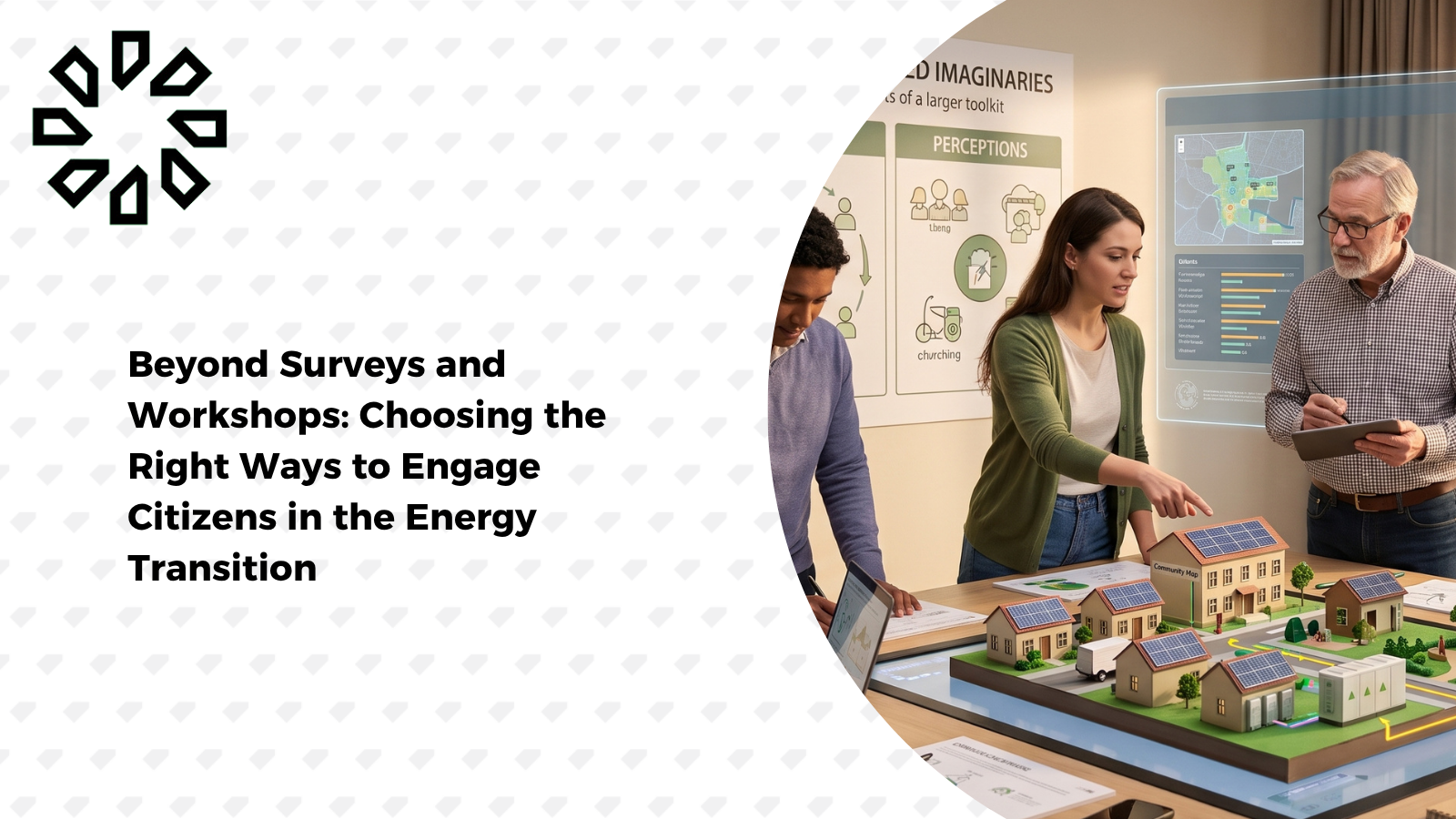
One particularly interesting form of participation involves developing shared imaginaries.
Instead of beginning with a predetermined technical solution, participants are encouraged to explore how they imagine their community or energy system developing in the future.
Narratives can make long-term energy transitions easier to discuss by connecting technological change with people’s experiences, values and expectations. Communities can develop visions of a desirable future and then consider the steps required to move from current conditions towards that vision.
This approach can be particularly useful because energy transitions unfold over long periods. Decisions made today about buildings, mobility, renewable energy and infrastructure may influence communities for decades.
Shared imaginaries create a space in which those futures can be discussed collectively rather than being defined exclusively by technical experts.
Co-creating technologies rather than simply introducing them
Participation can also directly influence the design of technologies and services.
In co-creation or co-design, users work alongside researchers, stakeholders and design experts to develop features of a technology or service.
The objective is therefore different from simply asking people whether they like a finished solution.
Participants can contribute at earlier stages, helping identify community objectives, desirable features and potential problems. Initial ideas can then be translated into prototypes and brought back to participants for further testing and refinement.
D4.1 notes that well-designed co-creation can do more than improve a technical artefact. The process can also contribute to learning and empowerment by giving participants a more meaningful role in shaping the technologies that may eventually affect them.
Listening to public perceptions
Not every engagement activity needs to involve co-design.
Sometimes the objective is to understand what people know, experience or think.
Surveys, focus groups, citizen panels and deliberative workshops can be used to elicit public perceptions and generate knowledge about attitudes, experiences and preferences.
These approaches are particularly useful when researchers or public institutions need to understand how a larger or more diverse group perceives an issue.
However, there is an important distinction between asking people for information and giving them influence over a decision or design process.
Recognising that distinction helps avoid treating every consultation exercise as the same level or form of participation.
Participation can also address behaviour, business models and justice
The range of engagement possibilities becomes even broader when local energy systems begin interacting with people’s everyday practices and economic decisions.
Participation may explore how energy behaviour changes in response to information or incentives. It may involve citizens in new commercial arrangements associated with local energy generation and exchange. Other approaches explicitly consider questions of justice and fairness within the energy transition.
D4.1’s review of participation observatories illustrates just how broad this landscape has become. Recorded forms of public engagement include deliberative workshops, community action, co-production, consumer action, living labs, financial incentives, public communication, digital engagement and everyday practices, among others.
There is therefore no universal participation technique suitable for every PED.
From participation for citizens to participation with citizens
Another important question concerns who controls the participatory process.
Many conventional engagement activities are designed by researchers or institutions. They decide who is invited, what questions are asked, what methods are used and how the resulting knowledge is incorporated into the project.
D4.1 identifies limitations in dominant approaches, including the fact that citizens are rarely involved across multiple stages of a research project or in the reintegration of the knowledge that participation creates. It points towards a need for greater interaction between citizens and experts and for participatory processes that provide meaningful benefits to participants themselves.
This represents an important shift in perspective.
The question is no longer simply “How can we get citizens to participate?”
It also becomes “How can participation itself be designed so that citizens have a meaningful role?”
Choosing engagement according to purpose
The diversity of participation techniques reviewed by InterPED leads to a simple but important conclusion: the method should follow the purpose and context.
A survey may be appropriate when the objective is to understand perceptions across a broad population. Co-design may be better when developing a technology that people will use. Shared imaginaries can support collective thinking about long-term transition. Other contexts may require approaches centred on behaviour, governance, justice or economic participation.
Effective citizen engagement therefore starts before the workshop, questionnaire or consultation takes place.
It starts by asking why participation is needed, who should participate and what influence participants should have over the process and its outcomes.
For Positive Energy Districts, where social, technical and economic systems increasingly intersect, answering those questions can be just as important as choosing the technology itself.
Learn more
This article draws on the InterPED public deliverable:
Peacock, A. (2024). D4.1: Guidelines for user recruitment and engagement. Zenodo.